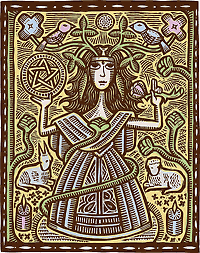
| |||
| J A N U A R Y 2 0 0 1
WICCA, sometimes known as the Goddess movement, Goddess spirituality, or the Craft, appears to be the fastest-growing religion in America. Thirty years ago only a handful of Wiccans existed. One scholar has estimated that there are now more than 200,000 adherents of Wicca and related "neopagan" faiths in the United States, the country where neopaganism, like many formal religions, is most flourishing. Wiccans -- who may also call themselves Witches (the capital W is meant to distance them from the word's negative connotations, because Wiccans neither worship Satan nor practice the sort of malicious magic traditionally associated with witches) or just plain pagans (often with a capital P) -- tend to be white, middle-class, highly educated, and politically involved in liberal and environmental causes. About a third of them are men. Wiccan services have been held on at least fifteen U.S. military bases and ships. | |||
| Many come to Wicca after reading The Spiral Dance: A Rebirth of the Ancient Religion of the Great Goddess (1979), a best-selling introduction to Wiccan teachings and rituals written by Starhawk (née Miriam Simos), a Witch (the term she prefers) from California. Starhawk offers a vivid summary of the history of the faith, explaining that witchcraft is "perhaps the oldest religion extant in the West" and that it began "more than thirty-five thousand years ago," during the last Ice Age. The religion's earliest adherents worshipped two deities, one of each sex: "the Mother Goddess, the birthgiver, who brings into existence all life," and the "Horned God," a male hunter who died and was resurrected each year. Male shamans "dressed in skins and horns in identification with the God and the herds," but priestesses "presided naked, embodying the fertility of the Goddess." All over prehistoric Europe people made images of the Goddess, sometimes showing her giving birth to the "Divine Child -- her consort, son, and seed." They knew her as a "triple Goddess" -- practitioners today usually refer to her as maiden, mother, crone -- but fundamentally they saw her as one deity. Each year these prehistoric worshippers celebrated the seasonal cycles, which led to the "eight feasts of the Wheel": the solstices, the equinoxes, and four festivals -- Imbolc (February 2, now coinciding with the Christian feast of Candlemas), Beltane (May Day), Lammas or Lughnasad (in early August), and Samhain (our Halloween). This nature-attuned, woman-respecting, peaceful, and egalitarian culture prevailed in what is now Western Europe for thousands of years, Starhawk wrote, until Indo-European invaders swept across the region, introducing warrior gods, weapons designed for killing human beings, and patriarchal civilization. Then came Christianity, which eventually insinuated itself among Europe's ruling elite. Still, the "Old Religion" lived, often in the guise of Christian practices. Starting in the fourteenth century, Starhawk argued, religious and secular authorities began a 400-year campaign to eradicate the Old Religion by exterminating suspected adherents, whom they accused of being in league with the devil. Most of the persecuted were women, generally those outside the social norm -- not only the elderly and mentally ill but also midwives, herbal healers, and natural leaders, those women whose independent ways were seen as a threat. During "the Burning Times," Starhawk wrote, some nine million were executed. The Old Religion went more deeply underground, its traditions passed down secretly in families and among trusted friends, until it resurfaced in the twentieth century. Like their ancient forebears, Wiccans revere the Goddess, practice shamanistic magic of a harmless variety, and celebrate the eight feasts, or sabbats, sometimes in the nude. Subject to slight variations, this story is the basis of many hugely popular Goddess handbooks. It also informs the writings of numerous secular feminists -- Gloria Steinem, Marilyn French, Barbara Ehrenreich, Deirdre English -- to whom the ascendancy of "the patriarchy" or the systematic terrorization of strong, independent women by means of witchcraft trials are historical givens. Moreover, elements of the story suffuse a broad swath of the intellectual and literary fabric of the past hundred years, from James Frazer's The Golden Bough and Robert Graves's The White Goddess to the novels of D. H. Lawrence, from the writings of William Butler Yeats and T. S. Eliot to Jungian psychology and the widely viewed 1988 public-television series The Power of Myth. In all probability, not a single element of the Wiccan story is true. The evidence is overwhelming that Wicca is a distinctly new religion, a 1950s concoction influenced by such things as Masonic ritual and a late-nineteenth-century fascination with the esoteric and the occult, and that various assumptions informing the Wiccan view of history are deeply flawed. Furthermore, scholars generally agree that there is no indication, either archaeological or in the written record, that any ancient people ever worshipped a single, archetypal goddess -- a conclusion that strikes at the heart of Wiccan belief. IN the past few years two well-respected scholars have independently advanced essentially the same theory about Wicca's founding. In 1998 Philip G. Davis, a professor of religion at the University of Prince Edward Island, published Goddess Unmasked: The Rise of Neopagan Feminist Spirituality, which argued that Wicca was the creation of an English civil servant and amateur anthropologist named Gerald B. Gardner (1884-1964). Davis wrote that the origins of the Goddess movement lay in an interest among the German and French Romantics -- mostly men -- in natural forces, especially those linked with women. Gardner admired the Romantics and belonged to a Rosicrucian society called the Fellowship of Crotona -- a group that was influenced by several late-nineteenth-century occultist groups, which in turn were influenced by Freemasonry. In the 1950s Gardner introduced a religion he called (and spelled) Wica. Although Gardner claimed to have learned Wiccan lore from a centuries-old coven of witches who also belonged to the Fellowship of Crotona, Davis wrote that no one had been able to locate the coven and that Gardner had invented the rites he trumpeted, borrowing from rituals created early in the twentieth century by the notorious British occultist Aleister Crowley, among others. Wiccans today, by their own admission, have freely adapted and embellished Gardner's rites. | |||
| In 1999 Ronald Hutton, a well-known historian of pagan British religion who teaches at the University of Bristol, published The Triumph of the Moon. Hutton had conducted detailed research into the known pagan practices of prehistory, had read Gardner's unpublished manuscripts, and had interviewed many of Gardner's surviving contemporaries. Hutton, like Davis, could find no conclusive evidence of the coven from which Gardner said he had learned the Craft, and argued that the "ancient" religion Gardner claimed to have discovered was a mélange of material from relatively modern sources. Gardner seems to have drawn on the work of two people: Charles Godfrey Leland, a nineteenth-century amateur American folklorist who professed to have found a surviving cult of the goddess Diana in Tuscany, and Margaret Alice Murray, a British Egyptologist who herself drew on Leland's ideas and, beginning in the 1920s, created a detailed framework of ritual and belief. From his own experience Gardner included such Masonic staples as blindfolding, initiation, secrecy, and "degrees" of priesthood. He incorporated various Tarot-like paraphernalia, including wands, chalices, and the five-pointed star, which, enclosed in a circle, is the Wiccan equivalent of the cross. Gardner also wove in some personal idiosyncrasies. One was a fondness for linguistic archaisms: "thee," "thy," "'tis," "Ye Bok of ye Art Magical." Another was a taste for nudism: Gardner had belonged to a nudist colony in the 1930s, and he prescribed that many Wiccan rituals be carried out "skyclad." This was a rarity even among occultists: no ancient pagan religion is known, or was thought in Gardner's time, to have regularly called for its rites to be conducted in the nude. Some Gardnerian innovations have sexual and even bondage-and-discipline overtones. Ritual sex, which Gardner called "The Great Rite," and which was also largely unknown in antiquity, was part of the liturgy for Beltane and other feasts (although most participants simulated the act with a dagger -- another of Gardner's penchants -- and a chalice). Other rituals called for the binding and scourging of initiates and for administering "the fivefold kiss" to the feet, knees, "womb" (according to one Wiccan I spoke with, a relatively modest spot above the pubic bone), breasts, and lips. Hutton effectively demolished the notion, held by Wiccans and others, that fundamentally pagan ancient customs existed beneath medieval Christian practices. His research reveals that outside of a handful of traditions, such as decorating with greenery at Yuletide and celebrating May Day with flowers, no pagan practices -- much less the veneration of pagan gods -- have survived from antiquity. Hutton found that nearly all the rural seasonal pastimes that folklorists once viewed as "timeless" fertility rituals, including the Maypole dance, actually date from the Middle Ages or even the eighteenth century. There is now widespread consensus among historians that Catholicism thoroughly permeated the mental world of medieval Europe, introducing a robust popular culture of saints' shrines, devotions, and even charms and spells. The idea that medieval revels were pagan in origin is a legacy of the Protestant Reformation. Hutton has also pointed out a lack of evidence that either the ancient Celts or any other pagan culture celebrated all the "eight feasts of the Wheel" that are central to Wiccan liturgy. "The equinoxes seem to have no native pagan festivals behind them and became significant only to occultists in the nineteenth century," Hutton told me. "There is still no proven pagan feast that stood as ancestor to Easter" -- a festival that modern pagans celebrate as Ostara, the vernal equinox. Historians have overturned another basic Wiccan assumption: that the group has a history of persecution exceeding even that of the Jews. The figure Starhawk cited -- nine million executed over four centuries -- derives from a late-eighteenth-century German historian; it was picked up and disseminated a hundred years later by a British feminist named Matilda Gage and quickly became Wiccan gospel (Gardner himself coined the phrase "the Burning Times"). Most scholars today believe that the actual number of executions is in the neighborhood of 40,000. The most thorough recent study of historical witchcraft is Witches and Neighbors (1996), by Robin Briggs, a historian at Oxford University. Briggs pored over the documents of European witch trials and concluded that most of them took place during a relatively short period, 1550 to 1630, and were largely confined to parts of present-day France, Switzerland, and Germany that were already racked by the religious and political turmoil of the Reformation. The accused witches, far from including a large number of independent-minded women, were mostly poor and unpopular. Their accusers were typically ordinary citizens (often other women), not clerical or secular authorities. In fact, the authorities generally disliked trying witchcraft cases and acquitted more than half of all defendants. Briggs also discovered that none of the accused witches who were found guilty and put to death had been charged specifically with practicing a pagan religion. If Internet chat rooms are any indication, some Wiccans cling tenaciously to the idea of themselves as institutional victims on a large scale. Generally speaking, though, Wiccans appear to be accommodating themselves to much of the emerging evidence concerning their antecedents: for example, they are coming to view their ancient provenance as inspiring legend rather than hard-and-fast history. By the end of the 1990s, with the appearance of Davis's book and then of Hutton's, many Wiccans had begun referring to their story as a myth of origin, not a history of survival. "We don't do what Witches did a hundred years ago, or five hundred years ago, or five thousand years ago," Starhawk told me. "We're not an unbroken tradition like the Native Americans." In fact, many Wiccans now describe those who take certain elements of the movement's narrative literally as "Wiccan fundamentalists." AN even more controversial strand of the challenge to the Wiccan narrative concerns the very existence of ancient Goddess worship. One problem with the theory of Goddess worship, scholars say, is that the ancients were genuine polytheists. They did not believe that the many gods and goddesses they worshipped merely represented different aspects of single deities. In that respect they were like animistic peoples of today, whose cosmologies are crowded with discrete spirits. "Polytheism was an accepted reality," says Mary Lefkowitz, a professor of classics at Wellesley College. "Everywhere you went, there were shrines to different gods." The gods and goddesses had specific domains of power over human activity: Aphrodite/Venus presided over love, Artemis/Diana over hunting and childbirth, Ares/Mars over war, and so forth. Not until the second century, with the work of the Roman writer Apuleius, was one goddess, Isis, identified with all the various goddesses and forces of nature. As Christianity spread, the classical deities ceased to be the objects of religious cults, but they continued their reign in Western literature and art. Starting about 1800 they began to be associated with semi-mystical natural forces, rather than with specific human activities. In the writings of the Romantics, for example (John Keats's "Endymion" comes to mind), Diana presided generally over the woodlands and the moon. "Mother Earth" became a popular literary deity. In 1849 the German classicist Eduard Gerhard made the assertion, for the first time in modern Western history, that all the ancient goddesses derived from a single prehistoric mother goddess. In 1861 the Swiss jurist and writer Johann Jakob Bachofen postulated that the earliest human civilizations were matriarchies. Bachofen's theory influenced a wide range of thinkers, including Friedrich Engels, a generation of British intellectuals, and probably Carl Jung. By the early 1900s scholars generally agreed that the great goddess and earth mother had reigned supreme in ancient Mediterranean religions, and was toppled only when ethnic groups devoted to father gods conquered her devotees. In 1901 the British archaeologist Sir Arthur Evans excavated the Minoan palace at Knossos, on Crete, uncovering colorful frescoes of bull dancers and figurines of bare-breasted women carrying snakes. From this scant evidence Evans concluded that the Minoans, who preceded the Zeus-venerating Greeks by several centuries, had worshipped the great goddess in her virgin and mother aspects, along with a subordinate male god who was her son and consort. Throughout the 1920s and 1930s archaeologists excavating Paleolithic and Neolithic sites in Europe and even Pueblo Indian settlements in Arizona almost reflexively proclaimed the female figurines they found to be images of the great goddess. The archaeologists drew on the work of late-nineteenth-century anthropologists. A belief that Stone Age peoples (and their "primitive" modern counterparts) did not realize that men played a role in human procreation was popular among many early British and American anthropologists. Female fertility was an awesome mystery, and women, as the sole sources of procreation, were highly honored. This notion -- that hunter-gatherer societies couldn't figure out the birds and the bees -- has since been discredited, but "it was very intriguing to people mired in Victorianism," according to Cynthia Eller, a professor of religious studies at Montclair State University, in New Jersey, who is writing a book on the subject. "They wanted to find a blissful sexual communism, a society in which chastity and monogamy were not important," Eller says. It was the same general impulse that led Margaret Mead to conclude in the 1920s that Samoan adolescents indulged in guilt-free promiscuity before marriage. | |||
| Archaeological expeditions even in the latter half of the century bolstered the notion of a single goddess figure from antiquity. In 1958 a British archaeologist named James Mellaart made a major find: a 9,000-year-old agricultural settlement that once housed up to 10,000 people at Çatalhöyük, one of the largest of several mounds near the modern-day town of Konya, in southern Turkey. Mellaart unearthed a number of female figurines that he deemed to be representations of the mother goddess. One was a headless female nude sitting on what appears to be a throne and flanked by leopards, with a protuberant belly that could be interpreted as a sign of pregnancy. The Çatalhöyük settlement contained no fortifications, and its houses were nearly all the same size, seemingly implying just the sort of nonviolent, egalitarian social system that Goddess-worshippers believe prevailed. Çatalhöyük became the Santiago de Compostela of the Goddess movement, with hundreds of pilgrims visiting the settlement annually. The enthroned nude is a revered Goddess-movement object. Mellaart's conclusions were bolstered by the work of the late Marija Gimbutas, a Lithuanian-born archaeologist who taught at the University of California at Los Angeles until 1989. Gimbutas specialized in the Neolithic Balkans. Like Mellaart, she tended to attach religious meaning to the objects she uncovered; the results of her Balkan digs were published in 1974 under the title The Gods and Goddesses of Old Europe. In 1982 Gimbutas reissued her book as The Goddesses and Gods of Old Europe, and she began seeing representations of the Goddess, and of female reproductive apparatus (wombs, Fallopian tubes, amniotic fluid), in a huge array of Stone Age artifacts, even in abstractions such as spirals and dots. In 1993 Ian Hodder, a Stanford University archaeologist, began re-excavating Çatalhöyük, using up-to-date techniques including isotopic analysis of the skeletons found in the graves. "Your bones reflect what you eat, even if you died nine thousand years ago," Hodder says. "And we found that men and women had different diets. The men ate more meat, and the women ate more plant food. You can interpret that in many ways. A rich protein diet is helpful for physical activity, so you could say that the men ate better -- but you could also argue that the women preferred plant food. What it does suggest is that there was a division of labor and activity" -- not necessarily the egalitarian utopia that Goddess worshippers have assumed. Hodder's team also discovered numerous human figurines of the male or an indeterminate sex, and found that the favorite Çatalhöyük representation was not women but animals. None of the art the team uncovered conclusively depicts copulation or childbirth. Hodder, along with most archaeologists of his generation, endeavors to assess objects in the context of where they were unearthed -- a dramatic change from the school of archaeology that was in vogue at the time of Mellaart's and Gimbutas's excavations. He points out that almost all the female figurines at Çatalhöyük came from rubbish heaps; the enthroned nude woman was found in a grain bin. "Very little in the context of the find suggests that they were religious objects," Hodder says. "They were maybe more like talismans, something to do with daily life." Furthermore, excavations of sites in Turkey, Greece, and Southeastern Europe that were roughly contemporaneous with the Çatalhöyük settlement have yielded evidence -- fortifications, maces, bones bearing dagger marks -- that Stone Age Europe, contrary to the Goddess narrative, probably saw plenty of violence. Lynn Meskell, an archaeologist at Columbia University who has published detailed critiques of Gimbutas's work, complains that Gimbutas and her devotees have promoted a romanticized "essentialist" view of women, defining them primarily in terms of fecundity and maternal gentleness. "You have people saying that Çatalhöyük was this peaceful, vegetarian society," says Meskell. "It's ludicrous. Neolithic settlements were not utopias in any sense at all." | |||
| The research of archaeologists like Hodder and Meskell has sparked heated rebuttals from Goddess theorists. "We know that even in the West most of art is religious art," says Riane Eisler, the author of the best seller The Chalice and the Blade (1987). "Don't tell me that suddenly these are dolls. Give me a break! You have a woman at Çatalhöyük sitting on a throne giving birth, and you want to call it a doll?" In her introduction to a new edition of The Spiral Dance, Starhawk -- who is working on a film about Gimbutas -- complains about "biased and inaccurate" academic scholarship aimed at discrediting her movement. Perhaps the most painful attack, as far as many Wiccans are concerned, came last June, with the publication of Cynthia Eller's The Myth of Matriarchal Prehistory. In 1993 Eller had published a sympathetic sociological study of feminist spirituality, Living in the Lap of the Goddess, which many in the movement put on their required-reading lists. Her recent work thus carries a tinge of betrayal, inasmuch as it puts her firmly in Hodder and Meskell's camp. Eller points out that almost no serious archaeologist working today believes that these ancient cultures were necessarily matriarchal or even woman-focused, and most do not interpret any of the things unearthed by Mellaart and Gimbutas as necessarily depicting goddesses or genitalia. Despite their ire, both Starhawk and Eisler, along with many of their adherents, seem to be moving toward a position that accommodates, without exactly accepting, the new Goddess scholarship, much as they have done with respect to the new research about their movement's beginnings. If the ancients did not literally worship a mother goddess, perhaps they worshipped her in a metaphoric way, by recognizing the special female capacity for bearing and nourishing new life -- a capacity to which we might attach the word "goddess" even if prehistoric peoples did not. "Most of us look at the archaeological artifacts and images as a source of art, or beauty, or something to speculate about, because the images fit with our theory that the earth is sacred, and that there is a cycle of birth and growth and regeneration," Starhawk told me. "I believe that there was an Old Religion that focused on the female, and that the culture was roughly egalitarian." SUCH faith may explain why Wicca is thriving despite all the things about it that look like hokum: it gives its practitioners a sense of connection to the natural world and of access to the sacred and beautiful within their own bodies. I am hardly the first to notice that Wicca bears a striking resemblance to another religion -- one that also tells of a dying and rising god, that venerates a figure who is both virgin and mother, that keeps, in its own way, the seasonal "feasts of the Wheel," that uses chalices and candles and sacred poetry in its rituals. Practicing Wicca is a way to have Christianity without, well, the burdens of Christianity. "It has the advantages of both Catholicism and Unitarianism," observes Allen Stairs, a philosophy professor at the University of Maryland who specializes in religion and magic. "Wicca allows one to wear one's beliefs lightly but also to have a rich and imaginative religious life." "Diotima Mantineia," age forty-eight, is the associate editor of the Web site The Witches' Voice, found at witchvox.com (she would not divulge her real name, partly because she lives in a southern town that she believes is unfriendly to neopagans). She summed up her feelings on the debunking of the official Wiccan narrative this way: "It doesn't matter to me how old Wicca is, because when I connect with Deity as Lady and Lord, I know that I am connecting with something much larger and vaster than I can fully comprehend. The Creator of this universe has been manifesting to us for all time, in the forms of gods and goddesses that we can relate to. This personal connection with Deity is what is meaningful. For me, Wicca works to facilitate that connection, and that is what really matters." Charlotte Allen is the senior editor of Crisis magazine and is a contributing writer for Lingua Franca. She is the author of The Human Christ: The Search for the Historical Jesus (1998). Illustration by Robert Zimmerman. This article was originally at http://www.theatlantic.com/cgi-bin/o/issues/2001/01/allen.htm. Copyright © 2001 by The Atlantic Monthly Company. All rights reserved. |